What Are “Flyovers” in Bird Monitoring?
If you’re new to bird surveying, you’ve probably heard someone mention “flyovers” and wondered what that means. Are they talking about birds that are flying? Migrating birds? Soaring? The answer is – kind of all of the above, but with a specific meaning in the context of bird monitoring.
Let’s break it down.
What Is a Flyover?
In bird monitoring, a flyover refers to a bird that is observed flying over a point or area without showing any signs of using the surrounding habitat at your survey site. These birds are just passing through the airspace above you – they’re not perching, nesting, feeding, or interacting with the environment where your survey is taking place.
You can think of them as birds “in transit.”
Why Does It Matter?
The main goal of most bird surveys is to assess which birds are using a particular area (e.g., a particular habitat, an impact area, a wetland, etc.). If a bird is just flying over your point count or transect area but not engaging with the habitat, it’s not technically using that habitat. Including flyovers alongside your other observations could lead to inaccurate conclusions about the activity of species within the area you are surveying.
So, understanding and correctly recording flyovers helps ensure your data reflect the birds associated with your site, not just birds passing through.
How to Record a Flyover
Most standardized bird monitoring protocols (like point counts, transects, or area searches) have a way to separately document flyovers. Here’s a typical approach:
- If you see or hear a bird flying over and you’re confident it never landed or used the habitat, mark it as a flyover.
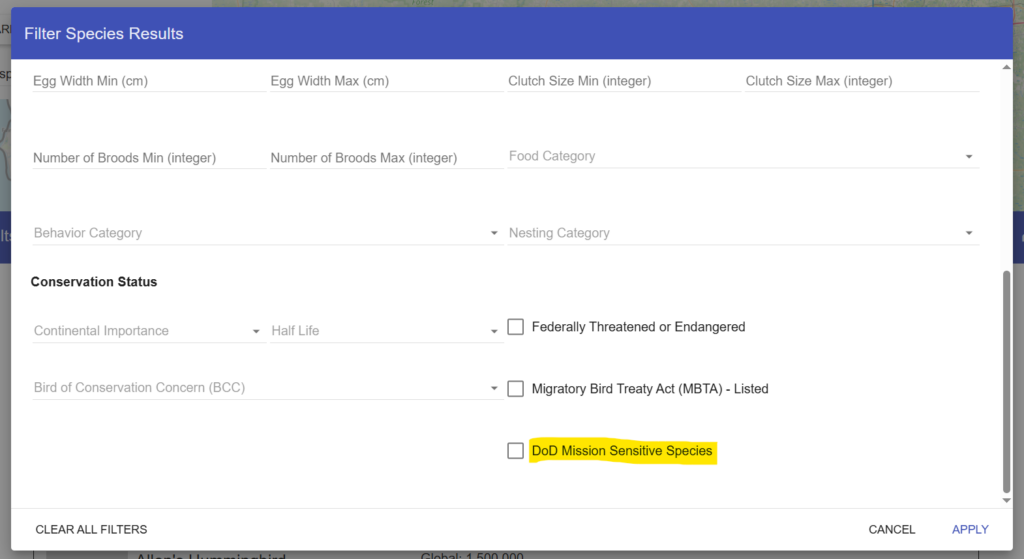
- Ensure your datasheets have a place to denote the flyover status of an observation, such as a distance bin (in point counts) or a detection cue. Avoid recording this information just in the comments of your data. Several AKN tools have functionality related to flyovers, but this information is not accessible when stored in a notes field. See more about this below.”
Examples of Flyovers
Here are some common examples:
- A flock of geese honking overhead while you’re surveying a forest plot.
- A raptor soaring high above your grassland point count that never drops to hunt.
- A lone gull cruising inland over a desert survey site.
In each case, the key detail is: the bird is not using the habitat you’re studying – just the airspace above it.
When It’s Not a Flyover
Not every bird in the air is a flyover. If a bird:
- Circles above your site hunting (e.g., a hawk scanning a field),
- Lands briefly in a tree or on the ground,
- Vocalizes repeatedly from overhead and seems to be interacting with the area (e.g., a territorial male singing in flight),
- Swifts and swallows foraging over an area (since they are eating bugs from the habitat below)
…it might count as being associated with the habitat, not just passing through.
How the AKN Supports Flyover Data
The AKN supports flyover data collection and helps users manage it meaningfully across tools and datasets. For many AKN Protocols, observers can often indicate whether an observation was a flyover in existing fields, such as distance bin (point counts) or detection cue.
More importantly, once data are in the AKN, you retain the power to filter and analyze based on those designations. For example:
- In tools like Analyst, users can choose to include or exclude flyovers when generating summaries or running queries.
- If your objective is to assess habitat use, you can filter out flyovers to avoid misrepresenting site-level usage.
- If you’re studying migration timing or flight corridors, you might want to focus on flyovers specifically.
The AKN system treats flyovers as a distinct attribute in your data, which means your analysis stays flexible and your data stay useful – no matter your research or reporting question.
Here are two examples of AKN Protocols that record Flyovers differently:
- Flyovers are recorded as part of a distance bin: 0_to_4m25_50_100M+
- Flyovers are recorded as a detection cue: KBO_VRPC_3
Final Thoughts
Flyovers are easy to overlook – or accidentally include – especially when you’re just starting out. But getting into the habit of noting whether a bird is truly using your survey site or just flying by is a great skill that will improve the quality and reliability of your data.
And with tools like those in the AKN, you don’t have to worry about losing those observations or being stuck with a one-size-fits-all dataset. The system is built to help you record, filter, and analyze flyover data in ways that support your unique monitoring goals.
So next time you’re in the field, keep an ear and eye to the sky – but remember to ask yourself: “Is a bird flying or is it a flyover?”.